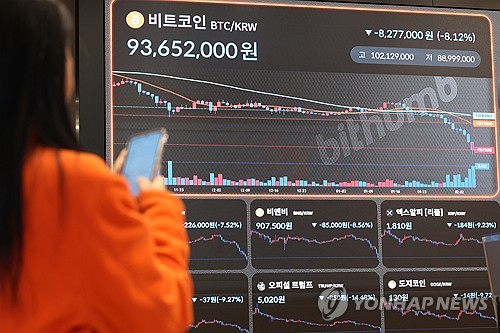
Bitcoin Under Threat at $60,000 Has the Trump Effect Backfired?
As Bitcoin (BTC) fell to threaten the $60,000 level and gave back all gains accumulated since Donald Trump’s election victory, the market assessment emerged that cryptocurrencies have become so-called “Trumped,” caught in cycles of boom and bust driven by political events. Strategists at Bloomberg Intelligence analyzed that a combination of three factors—an explosion of altcoins, macroeconomic uncertainty, and misconceptions surrounding the halving cycle—are collectively weighing on Bitcoin.
According to DL News on February 6 (local time), Bitcoin slid to near $60,000 at one point intraday on Friday, marking a 30% decline over the past month. This represents a drop of nearly 50% from its peak, while recent forced liquidations totaling about $2 billion have amplified market volatility. Mike McGlone, a strategist at Bloomberg Intelligence, assessed that the crypto market is trapped in a boom-and-bust cycle triggered by Trump’s victory and subsequent support.
The first factor pressuring market sentiment is employment data posting the worst figures since the 2009 financial crisis. Reports that more than 100,000 people were laid off in the United States in January alone pushed New York stock markets, including the S&P 500 and Nasdaq, down more than 1% in tandem, fueling risk-off sentiment. McGlone warned that the current environment resembles the 2008 financial crisis and presented a pessimistic outlook in which Bitcoin could fall as low as $10,000 in the worst-case scenario.
Another factor limiting Bitcoin’s dominance is the exponential increase in competing assets. McGlone noted that while there was only Bitcoin in 2009, more than 28 million cryptocurrencies now exist. He pointed out that meme coins such as Dogecoin (DOGE), with a market capitalization of $15 billion, and Shiba Inu (SHIB), around $3 billion, are dispersing market liquidity and diluting Bitcoin’s scarcity value.
Macroeconomic uncertainty, particularly concerns surrounding Kevin Warsh as a prospective Federal Reserve chair nominee, is also weighing on the market. Considered a prominent hawk, Warsh is viewed as favoring tight monetary policy to curb inflation. McGlone projected that Warsh would be reluctant to stimulate the economy until ahead of the 2026 midterm elections due to concerns about a resurgence of inflation, thereby constraining market liquidity.
Fabian Dori, Chief Investment Officer at Sygnum Bank, analyzed that fears surrounding the four-year cycle driven by Bitcoin halvings are prompting long-term holders to sell. He explained that anxiety over a repeat of past crash patterns ahead of the 2028 halving is releasing additional supply into the market. However, Dori added that the current market is approaching a state of exhaustion at the peak of fear and that, considering fundamentals and the growth of stablecoins, Bitcoin’s long-term investment value remains intact.
*Disclaimer: This article is for investment reference only, and no responsibility is taken for any investment losses based on it. The content should be interpreted solely for informational purposes.*
<저작권자 ⓒ 코인리더스 무단전재 및 재배포 금지>
|


  많이 본 기사
English 많이 본 기사
|